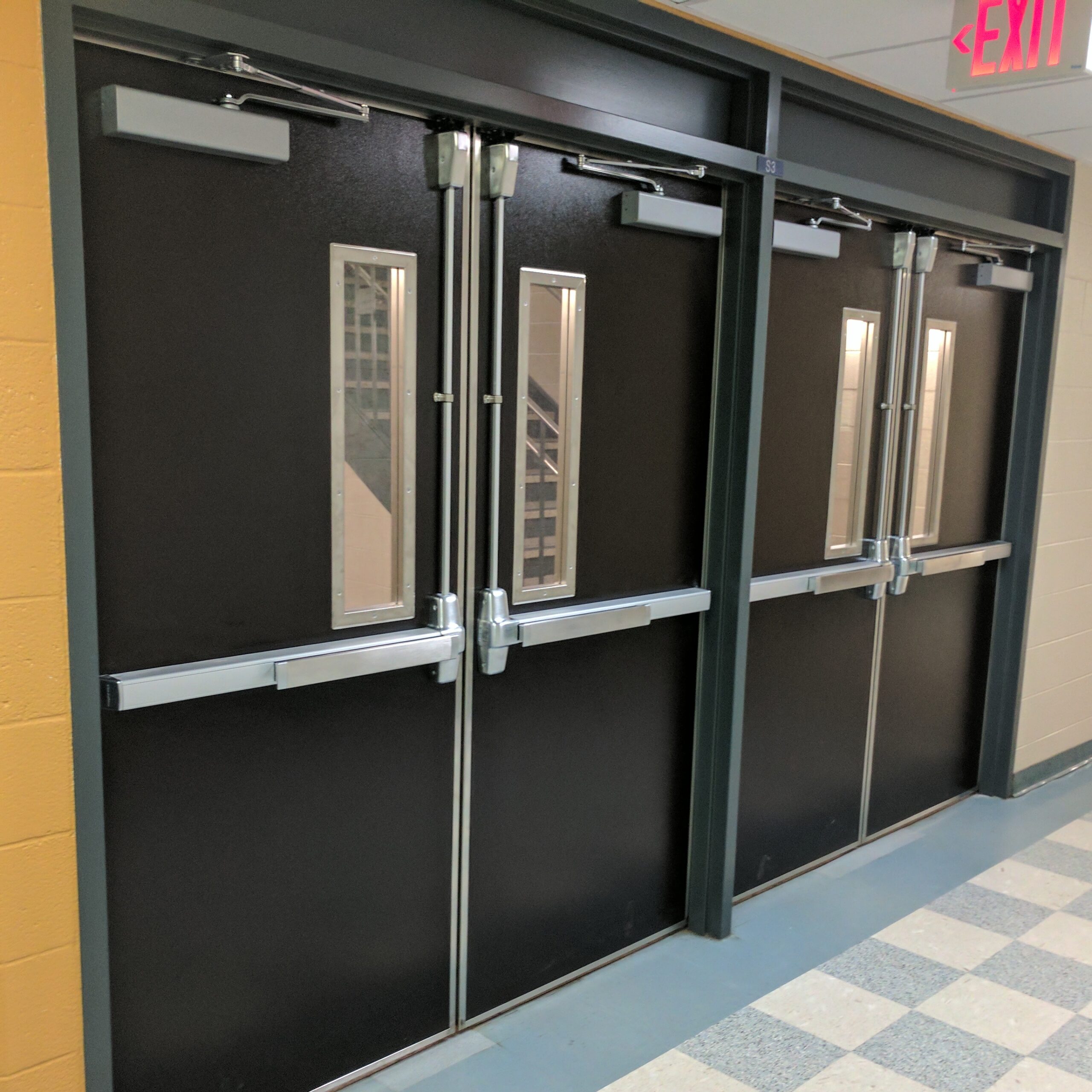
Door hardware has its own vocabulary, and work orders, inspection reports and quotes all use it. This glossary explains the terms a facility manager or property manager is most likely to come across, in plain language.
- Access control
- A system that decides who can open a door and when, using cards, fobs or codes in place of keys.
- Active leaf
- On a pair of doors, the leaf that opens first and carries the lock or exit device.
- Astragal
- A strip fixed to the meeting edge of a pair of doors to close the gap between them.
- Backset
- The distance from the edge of the door to the centre of the lock or cylinder.
- Closer
- A hydraulic device that closes a door at a controlled speed after it has been opened.
- Continuous hinge
- A hinge that runs the full height of the door and spreads the load along the whole edge. Common on heavy, high-traffic doors.
- Coordinator
- A device on a pair of doors that makes the inactive leaf close before the active leaf, so the pair latches correctly.
- Cylinder
- The keyed part of a lock. Rekeying or replacing the cylinder changes which key works without replacing the whole lock.
- Cylindrical lock
- A lock installed through holes bored in the door. Simpler to fit than a mortise lock.
- Deadbolt
- A bolt with no spring, thrown and retracted by a key or thumbturn.
- Deadlatch
- A latch with a small auxiliary pin that stops the latch being pushed back while the door is closed.
- Delayed egress
- Exit hardware that keeps the door locked for a short, fixed time after it is pushed, while sounding an alarm. Its use is controlled by building and fire codes.
- Dogging
- Holding the latch of an exit device retracted so the door works as push and pull. Fire-rated exit devices cannot be mechanically dogged.
- Electric strike
- A strike that releases electrically, so a locked door can be opened without retracting the latch.
- Electromagnetic lock
- An electromagnet on the frame that holds a steel plate on the door. Often called a maglock. It releases when power is cut.
- Exit device
- A bar or pad across the inside of a door that releases the latch when pushed. Also called panic hardware or a crash bar.
- Fail safe and fail secure
- Fail safe hardware unlocks when power is lost. Fail secure hardware stays locked. Either way, people inside must still be able to leave.
- Fire exit hardware
- An exit device that has been tested and labelled for use on a fire-rated door.
- Fire label
- The label on a fire-rated door or frame that shows its rating. A missing or painted-over label is an inspection deficiency.
- Flush bolt
- A bolt recessed into the edge of the inactive leaf that secures it at the top and bottom.
- Handing
- The direction a door swings, described as left hand or right hand. Handing decides which hardware will fit.
- Hold-open
- A device that keeps a door open. On a fire door, a hold-open has to release automatically when the fire alarm sounds.
- Hollow metal
- Doors and frames formed from sheet steel. The standard construction for commercial and fire-rated openings.
- Inactive leaf
- On a pair of doors, the leaf that stays closed in normal use and is held by flush bolts or a vertical rod device.
- Interchangeable core
- A cylinder core that can be removed with a control key and swapped in seconds, without taking the lock apart.
- Jamb
- The vertical side of a door frame. The top of the frame is the head.
- Keyway
- The shape of the slot that accepts the key. A restricted keyway is controlled so that key blanks are not sold on the open market.
- Latch bolt
- The spring-loaded bolt that holds a door closed and retracts when the handle or exit device is operated.
- Lite
- A glazed opening in a door. Also called a vision lite.
- Low-energy operator
- An automatic operator that opens a swing door slowly and with limited force when someone presses a push plate.
- Master key system
- A keying plan in which each door has its own key and selected keys open groups of doors.
- Mortise lock
- A lock whose body sits in a pocket cut into the edge of the door. Heavier duty than a cylindrical lock.
- Mullion
- A vertical post between the two leaves of a pair of doors. A removable mullion can be taken out for wide loads.
- Pivot
- Hardware at the top and bottom of a door on which it swings. Used in place of hinges on heavy or high-traffic doors.
- Push plate
- The wall or post button that activates an automatic door operator. Also called an actuator.
- Rekey
- Changing the pins in a cylinder so that a new key works and the old key no longer does.
- Request to exit
- A sensor or button that tells an access control system someone is leaving, so the door releases without an alarm. Often shortened to REX.
- Strike
- The plate on the frame that receives the latch or bolt.
- Sweep
- A seal fitted to the bottom of a door to close the gap at the floor.
- Threshold
- The strip across the floor of a doorway that the door closes over.
- Vertical rod device
- An exit device that latches at the top, the bottom or both, using rods that run up and down the door.
- Weatherstripping
- Seals around the edge of a door or frame that keep out drafts, water, smoke or sound.